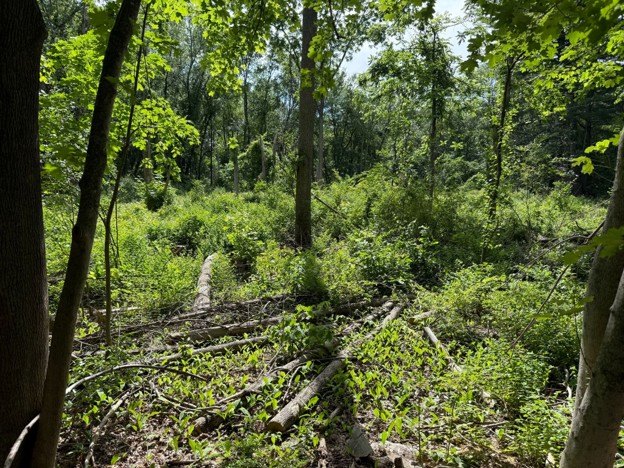
Holden Moore has spent six months pulling invasive plants by hand in the forests of Minute Man National Historical Park, trying to give native trees room to grow.
Moore, a Resilient Forestry Intern placed through the Forest Stewards Guild, is part of a broader National Park Service effort to reverse what scientists call "regeneration debt." The term describes forests that still have large, mature trees but lack the seedlings and saplings needed to replace them. At Minute Man, the condition threatens to leave gaps in the canopy that invasive species would fill instead of native oaks, maples and beeches.
"Building the next forest does not necessarily begin with planting," Moore wrote in a Monday, Sept. 14, essay on the Friends of Minute Man website. The first step, he explained, is clearing the invasive vegetation that crowds out young native trees.
Three forest parcels at the Concord park have been selected for restoration. The work ranges from hand-pulling garlic mustard and black swallow-wort to cutting porcelain berry and bittersweet vines. For areas with especially dense invasive cover, large-scale mechanical treatment using mulching equipment is planned.
The threats go beyond invasive plants. Ash trees across the park are dying from the emerald ash borer, an introduced insect. Beech trees face a separate crisis from beech leaf disease, caused by a microscopic nematode. Felled ash trees are already visible along trails and near Monument Street in Concord, close to the Reformatory Trail, according to a May 2026 Friends of Minute Man article.
Moore's internship falls under the National Park Service's Resilient Forests Initiative (RFI), which operates across 20 eastern national parks. The program has planted 5,300 trees and restored 642 acres across its network, according to the NPS Inventory and Monitoring Division. Minute Man received approximately $410,000 in Inflation Reduction Act funds for forest and grassland restoration, the NPS announced in March 2024.
The Forest Stewards Guild and Redstart, Inc. are working alongside park staff on the ground. Long-term goals for the three parcels include encouraging natural regeneration and planting native trees to build a diverse future canopy.
Moore wrote that the work will take years. Invasive plants can resprout or return from existing seed banks, meaning several rounds of treatment and continued follow-up may be needed before native species can establish.
Superintendent Simone Monteleone said in a March 15, 2024, statement that improving forest and grassland health is essential to protecting the park for both wildlife and visitors.
The park has not announced upcoming volunteer dates for the restoration work. Minute Man National Historical Park can be reached at 978-369-6993.