Robert Coles spent 60 years living in Concord, won a Pulitzer Prize, earned the Presidential Medal of Freedom, and wrote more than 50 books. Even some of his neighbors had no idea.
Coles, the child psychiatrist and Harvard professor whose five-volume "Children of Crisis" series documented the inner lives of America's most vulnerable kids, died June 4 at age 97 in a Lincoln hospice.
"He was rather a low-key guy, like so many people in Concord," said Dan Esty, now a Yale professor, who took a freshman seminar with Coles in the late 1970s. "There's enormous talent in Concord, across the entire community. People are unaware of their professional status and accomplishment. Coles was one of those people."
Khakis, crayons, and a frayed blue shirt.
Concord psychiatrist Neal Kass, Coles' student at Harvard in 1976, remembers his professor's uniform: khakis and a frayed blue Oxford shirt, no tie — what Kass called "super radical" at a school as buttoned-down as Harvard. AP photographer Jon Chase, who photographed Coles at his Concord home in 1998, recalled a workspace buried in books and papers. "His shirt would be partially untucked and the shirt tail hanging out," Chase said. "His hair was always messed up, not parted or combed neatly."
That casual appearance sat alongside meticulous, patient work. Coles built his career by walking into the homes of African American children facing racism, children of migrant farmworkers, and refugee families. He sat with them. He brought crayons.
A boy, a crayon, and a story about atrocity.
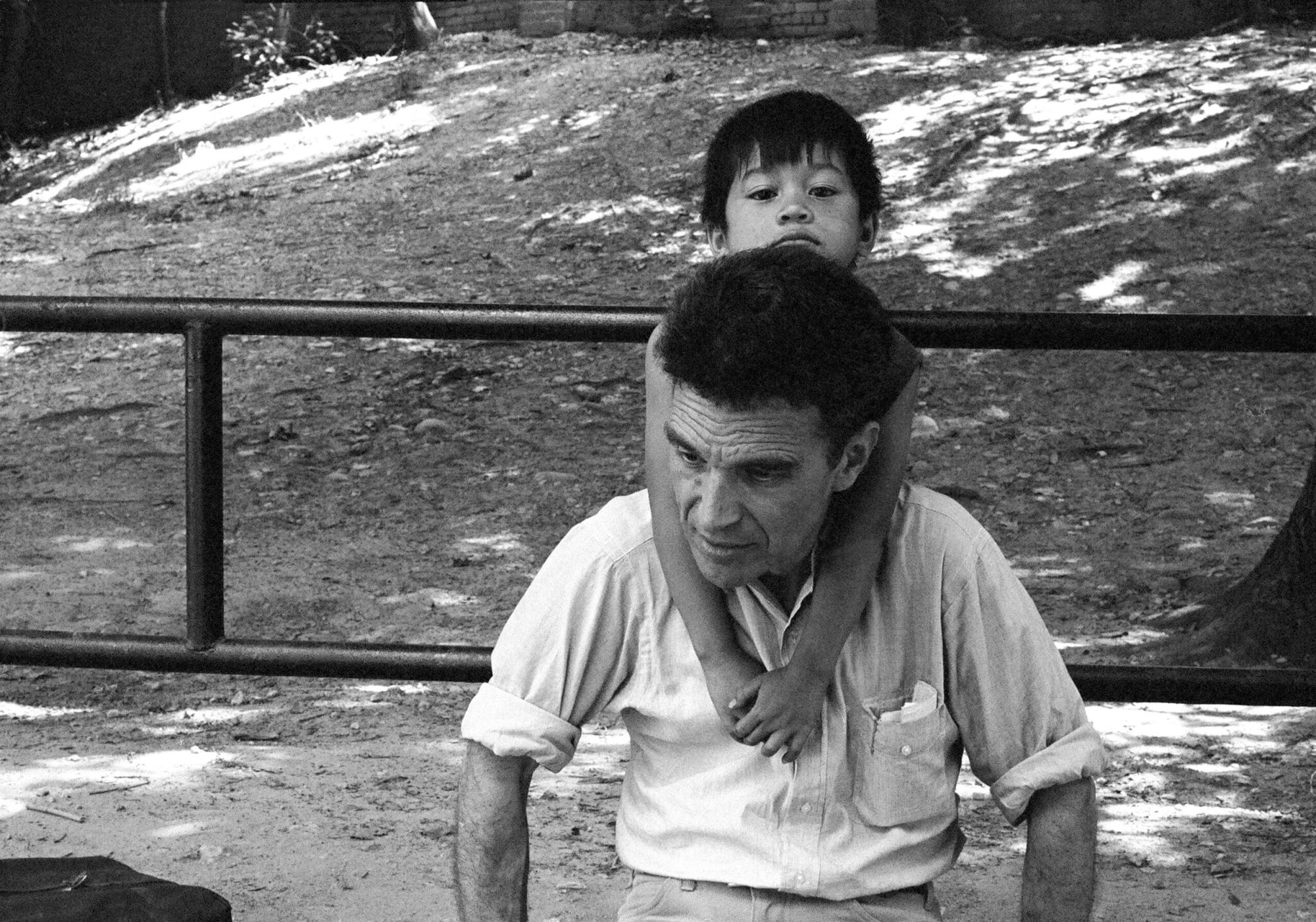
Duke University professor Alex Harris collaborated with Coles on a 1984 story about Cambodian refugee children in Alexandria, Virginia, photographing Coles as he worked. "Coles arrived with crayons and an ability to listen that left him astounded," Harris recalled. One photograph shows a young boy draping his arms around Coles' neck, both of them exhausted. Harris said Coles later explained the boy had just told him about an atrocity in his village that the child had overheard his parents discussing.
When Harris learned Coles was in hospice, he wrote him a letter this January and enclosed that photograph. Coles' son Michael told Harris his father was fascinated to see the picture again — one small memory, resurfacing near the end.
"Guilt 33."
At Harvard, Coles taught a course on moral and social inquiry that students nicknamed "Guilt 33," later growing into "Guilt 105" as General Education 105, enrolling as many as 850 students at its peak in the 1980s and '90s. Kass said the class was Coles' way of challenging privileged students to actually see what was right in front of them. "He was bringing the reality of the human beings living next to you while you're in your Harvard tower," Kass said.
A career built on paying attention.
Born in Boston in 1928, Coles graduated from Harvard in 1950 and earned his medical degree from Columbia in 1954. His "Children of Crisis" series, published from 1967 to 1977, won the Pulitzer Prize for General Nonfiction in 1973 and was later ranked among the century's 100 best English-language nonfiction works. He received a MacArthur "genius grant" in 1981 and co-founded the Center for Documentary Studies at Duke in 1989.
For all his gift for listening to others, Coles also knew when he simply wanted quiet. Kass once tried to strike up conversation with him at an airport, only to be gently rebuffed. "At one point I said, 'I get the feeling you'd rather be alone,'" Kass recalled. "He looked up and said, 'Thank you, exactly,' and went about reading his paper."