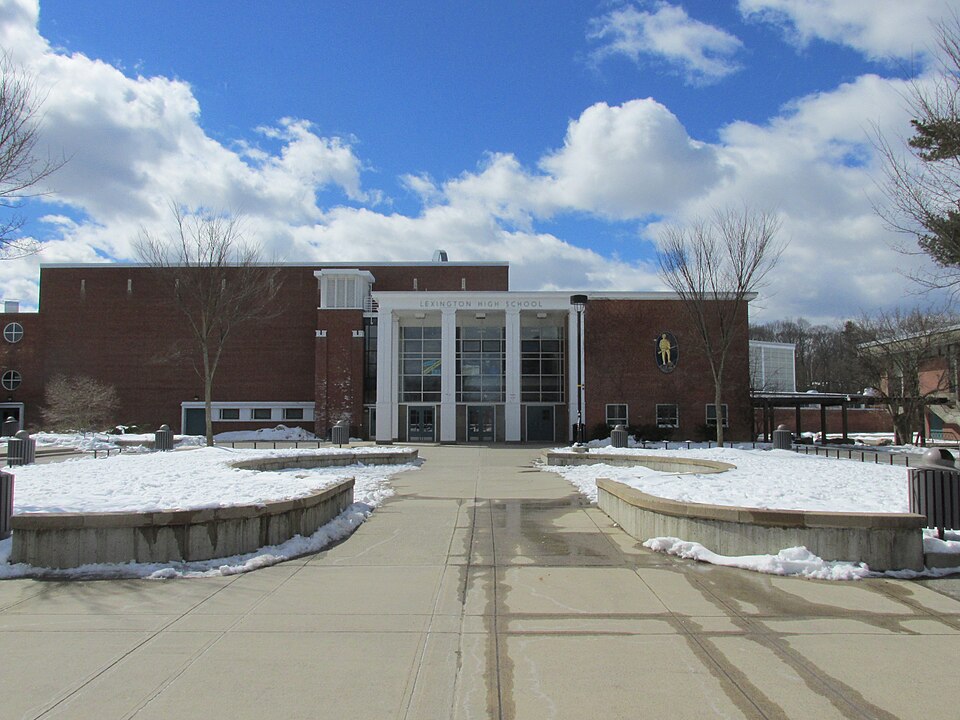
A Lexington Climate Action Network board member is urging the town to add a rainwater harvesting system to the new $660 million Lexington High School before the design window closes.
Rachel Summers, who runs a 5,000-gallon cistern system at her own home, laid out the case in a letter published Aug. 5 in The Lexington Observer. She argues that capturing roof runoff at the new school could pay for itself within about 10 years, then supply free irrigation for sports fields and serve as an emergency water backup in perpetuity, all without drawing on town supply or the Quabbin watershed.
"We've been pretty spoiled with easy access to water for decades, but that system is only going to be as good as predictable rainfall and heat, and careful management of the Quabbin watershed," Summers wrote. "When it all works well, it's miraculous. But miraculous and resilient aren't the same thing."
What she's proposing
Summers' home system pipes roof runoff through downspouts into three buried tanks, then pumps it out through drip irrigation. She calculates that each inch of rain on 1,000 square feet of roof yields 620 gallons. Designing capture into new construction, she wrote, can be "surprisingly cheap" compared to retrofitting. Her own setup cost roughly the same as a code-required stormwater tank, though it required special town approval because it isn't technically code-compliant.
She acknowledged the estimate is "back-of-napkin math" and that she is not an engineer. The incremental upfront costs would need financing.
What the project already includes
The new 440,000-square-foot school, approved by Lexington voters on Dec. 8, 2025, with 61.7% support, is scheduled to open for the 2029-2030 school year. Construction was set to begin in July 2026. The project team includes Dore + Whittier as owner's project manager, SMMA as architect and Turner Construction as construction manager.
Green features already in the design include geothermal wells, photovoltaic arrays, high-efficiency HVAC systems and enhanced daylighting, according to MSBA feasibility documents and the project FAQ. Rainwater harvesting does not appear in any publicly available design documentation.
The Sustainable Lexington Committee has a seat on the School Building Committee through member Dan Voss. Permanent Building Committee Chair Jonathan A. Himmel also serves on the SBC.
The police station precedent
Summers drew on her own experience hand-watering native plantings at Lexington's LEED Silver police station. The building earned a "No Irrigation Required" credit, but during a two-year establishment period, someone must keep new plants alive by hose. Summers said she ran two hoses full blast for about 90 minutes, one to two times per week, using an estimated 1,000 to 2,000 gallons per visit.
A rainwater system, she argued, could have eliminated that demand.
Neither the School Building Committee nor the Permanent Building Committee has publicly responded to the proposal. The SBC found $2.3 million in savings through a Targeted Value Design process earlier this year. Whether rainwater capture was evaluated during that process remains unclear.