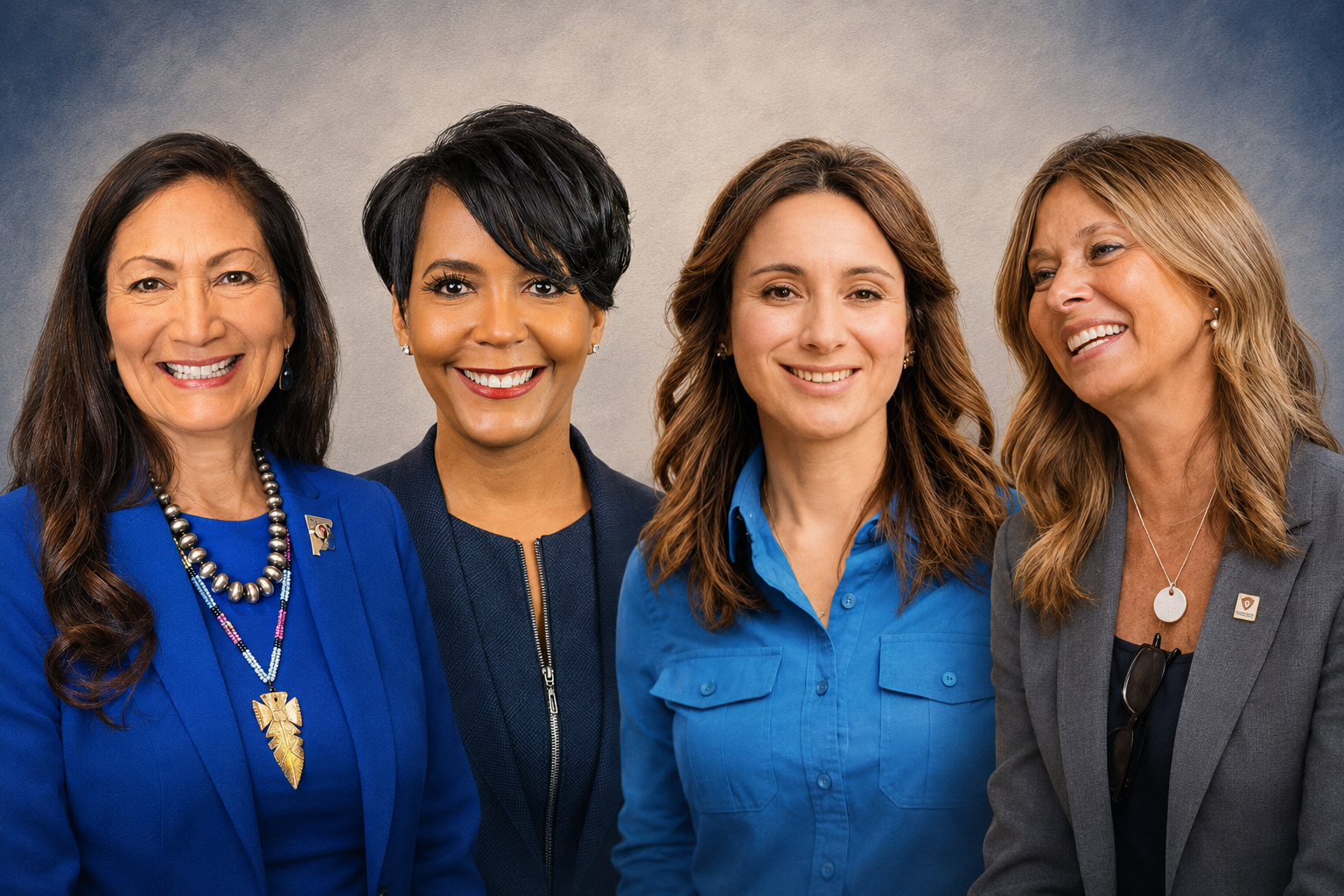
The most consequential word in the story of women’s electoral victories on Nov. 3 may be “governor.”
Keisha Lance Bottoms in Georgia, Gina Hinojosa in Texas and Deb Haaland in New Mexico broke barriers of race and gender in winning offices that carry budgets, appointments and vetoes. Amy Acton won Ohio. Amy Klobuchar won Minnesota. Marsha Blackburn won Tennessee. These were elections for the authority to make decisions affecting millions of people.
Together, the results challenge the habit of treating women’s electability as a special problem – and an electorate willing to choose them as a surprise.
“It never bothered me that they doubted me. It bothered me that they doubted us,” Hinojosa told supporters in Austin.
A different picture of power
Bottoms will become the first Black woman elected governor in American history. Haaland will be the first Native American woman to hold a governorship, and Hinojosa the first Latina governor of Texas.
In her victory speech, Bottoms spoke of her visit to the historic city of Crawfordsville, home of her enslaved ancestors and the vice president of the Confederacy.
“I visited the grave of Betsy Peak, my great-great-grandmother, who was born in 1845, 20 years before emancipation. In a cemetery filled with unmarked graves, I found hers,” Bottoms said “I don’t know what dreams Betsy Peak had for her children or for her grandchildren or the generations that she would never meet, but I know I am standing on shoulders made of steel.
“So, yes, Crawfordville produced the Confederacy’s vice president, but tonight it also produced your next governor.
Acton is Ohio’s first woman elected governor. She dedicated her victory to Ohioans seeking public servants “who solve problems instead of making them and do not mistake kindness for weakness,” she said in her election-night speech.
Blackburn and Klobuchar will be the first women governors of Tennessee and Minnesota.
Tennessee’s breakthrough was assured before the votes were counted: Blackburn and Democrat Jerri Green were competing to become the state’s first woman governor. Blackburn’s victory underscores that women’s growing political authority encompasses sharply different governing agendas.
The Senate will change, too.
Illinois elected Juliana Stratton, whose arrival alongside Maryland’s Angela Alsobrooks and Delaware’s Lisa Blunt Rochester will put three Black women in the chamber simultaneously for the first time. Stratton and Tammy Duckworth will also make Illinois the first state represented by two women of color senators. Minnesota elected Peggy Flanagan, the first Native American woman elected to the Senate.
Further down the ballot, Denise Powell’s House victory will make her Nebraska’s first Latina member of Congress. Adrienne Adams won election as New York’s first Black woman lieutenant governor.
The accumulated firsts demonstrate both change and its long delay. Institutions can celebrate opening their doors while still having to explain why those doors remained closed for so long.
What voters chose, and what we cannot yet know
These results show that winning coalitions in very different states entrusted women with executive power. They do not establish that voters everywhere have shed gender bias, or that gender was the principal reason any particular candidate won.
Democratic women also benefited from a broader election that punished Republicans, including in states long considered difficult Democratic territory. A favorable partisan climate and a candidate’s individual strength can operate together.
The more useful question is whether political gatekeepers have been too quick to anticipate voters’ prejudices – and too slow to recognize their priorities.
Before the election, New Jersey Gov. Mikie Sherrill told ABC News that strategists had drawn the wrong lesson from 2024 by believing Democrats needed a “male bro culture” to project toughness. She pointed instead to the success of “steely-eyed women” and emphasized authenticity.
Tuesday does not settle that argument. It gives it fresh evidence.
A candidate who talks convincingly about hospitals, schools and household finances can build an appeal that includes her identity without being confined by it. For parties deciding whom to recruit and donors deciding whom to finance, that distinction has practical consequences.
Kelly Dittmar, director of research at Rutgers University’s Center for American Women and Politics, warned before the election that historic candidacies alone would not deliver equality.
“But achieving gender parity among candidates, nominees, and officeholders will only happen if elevating women is a priority for both parties,” she said in an August statement.
The limits of cruelty
Ohio offers the night’s sharpest test of the proposition that a woman’s personal history can be turned into evidence against her fitness to lead.
Republican Vivek Ramaswamy’s campaign aired an advertisement featuring Acton’s estranged mother questioning her honesty and mental fitness. FactCheck.org reported that records and other evidence corroborated key elements of Acton’s account of childhood hardship and abuse. Her mother had lost custody after Acton’s stepfather was charged with sexually abusing her.
The ad invited voters to regard Acton’s account of vulnerability as a reason to distrust her. That is what made the episode larger than an ordinary dispute over a candidate’s record.
Acton offered a different definition of strength.
“But kindness shouldn’t be seen as weakness,” she told ABC News during the campaign.
She won. In her election-night remarks, she declared: “The healing begins today.”
The defensible conclusion is that the attack failed to stop her. Establishing how many voters it repelled – or whether it changed the outcome – requires evidence beyond the result itself. But Ohio’s next governor will be the woman whose credibility the advertisement sought to destroy.
Another challenge to conventional ideas of authority emerged in South Carolina, where retired Navy Vice Adm. Nancy Lacore claimed victory in a Republican-held congressional district after Defense Secretary Pete Hegseth removed her as Navy Reserve chief last year.
Her candidacy carried a pointed question: What happens when a woman dismissed by Washington’s male-centered leadership takes her qualifications directly to voters? Announcing her campaign, she wrote on X, “I still have more to give, more to fight for, more work to do.”
She turned the abrupt end of a 35-year military career into the beginning of a political one.
Flanagan, meanwhile, used social media to assert the authority of her own voice. In an Oct. 13 post on X, she described her Ojibwe name and wrote: “My Ojibwe name is Gizhiiwewidamookwe, which means ‘Speaks in a Loud and Clear Voice Woman.’ I’m going to be Minnesota’s voice in the U.S. Senate — not Donald Trump’s.”
The policy test begins now
The first policy consequence of these elections is straightforward: different people will decide which problems receive attention, which officials get appointed and which bills become law.
In Texas, Hinojosa campaigned to end private-school vouchers and state takeovers of school districts and to increase teacher pay, according to The Texas Tribune. Those commitments make her victory a potential turning point for public education, subject to legislative cooperation.
In Georgia, Bottoms proposed Medicaid expansion, a $15 minimum wage and repeal of the state’s six-week abortion ban.
In New Mexico, Haaland’s healthcare plan calls for working toward a public coverage option, strengthening the medical workforce and partnering with Tribal nations to address gaps in care.
Her explanation of her own background linked representation directly to economic experience. In remarks after winning the June primary, published by her campaign, she said: “I’m a single mom. I’ve lived paycheck to paycheck. I survived off of SNAP and WIC.”
Flanagan’s published agenda similarly connects her childhood reliance on public programs with proposals for expanded healthcare, paid family leave and universal child care.
These are commitments that can be measured against budgets, legislation and implementation. Calling them “women’s issues” understates their reach: school quality, medical bills and the cost of raising children shape the economy for everyone.
The women elected Tuesday will disagree about how government should respond. Gender does not erase party, ideology or the institutional limits on any governor or senator.
The next breakthrough may begin at your local school board meeting
The effects could also reach women who already serve on city councils, school boards and county commissions – and others who have never considered putting their names on a ballot.
There is research behind that possibility.
A 2018 study by Christina Ladam, Jeffrey Harden and Jason Windett, published in the American Journal of Political Science, examined elections from 1978 through 2012 and found that women serving as governors or U.S. senators encouraged more women to run for state legislatures. The authors also found evidence of an effect across state borders, suggesting inspiration could matter beyond direct recruitment.
Research by political scientists Christina Wolbrecht and David Campbell adds a qualification: visibility does not affect every woman in the same way.
“It is those younger women who we find respond to the presence of female politicians by becoming more politically engaged,” Wolbrecht said in a 2017 Notre Dame account of their research.
Neither study predicts a guaranteed wave of local candidacies after this election. Both suggest that a historic victory can change political participation beyond the office being contested.
Of the half a million elected officials at all levels of government in the United States, roughly one-third are women, according to the Center for American Women and Politics.
For a council member considering a legislative race, or a young woman deciding whether politics has room for her, Tuesday supplies examples of women winning authority in places and institutions where it had previously eluded them.
Turning that possibility into candidates will take recruitment, money, mentoring and help navigating the demands of campaigning. Parties celebrating these victories will reveal the depth of their commitment through whom they support next.
The immediate test belongs to the winners: whether they deliver on the promises that earned them power. The longer test belongs to the institutions around them: whether they continue treating successful women as exceptions, or change their assumptions about who can win.
Distributed by Surround Sound News